


Mechanical barometers have been reading the sky accurately for over 175 years. The look hasn't changed much in that time. Round dial, brass case, a needle that quietly tells you more than your phone does. What has changed is how little most people understand about what's actually happening inside one.
Plenty of the world's best mechanical barometers are still handcrafted the same way they always have been: skilled hands, precision engineering, and no shortcuts.
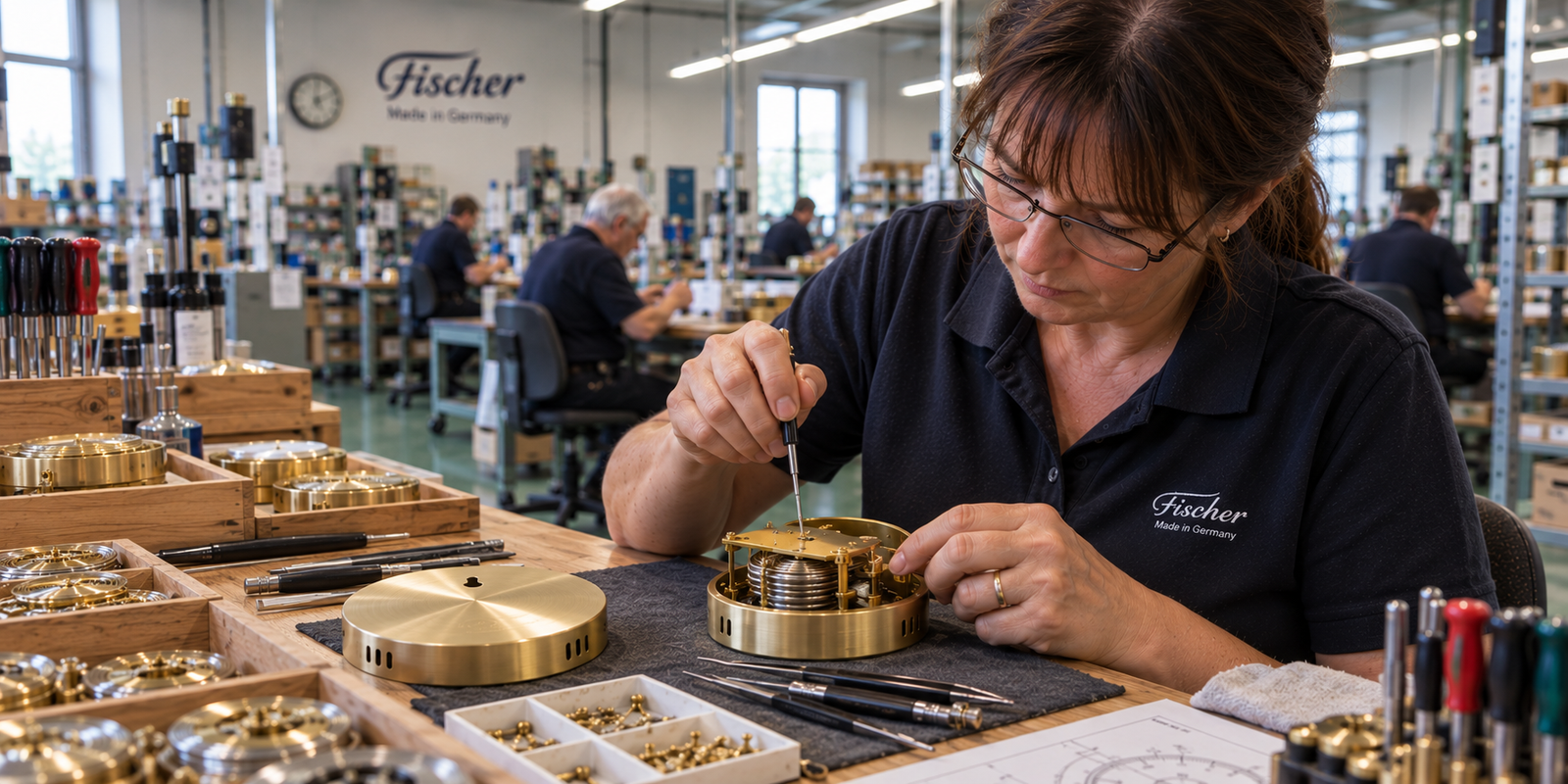
At Barometers & Clocks, we've stood on the factory floor at Fischer Instruments in Germany and watched it happen. Here's what's actually inside the instrument on your wall.
It Starts With the Aneroid Capsule
Every mechanical barometer runs on the same small piece of engineering: the aneroid capsule.
It's a sealed metal capsule with a partial vacuum inside. As atmospheric pressure changes:
- The capsule expands when pressure falls.
- The capsule compresses when pressure rises.
The movement is tiny. Fractions of a millimetre. But it's enough to drive the entire instrument, no battery required.

Precision Mechanical Linkages
That tiny capsule movement gets passed through a chain of springs, levers, gears and pivot points, each one amplifying the motion until it becomes the smooth sweep of the needle you actually read.
Every one of those parts has to be machined to fine tolerances. Get one slightly wrong and the whole chain reads inaccurately, which is exactly why this isn't a job for a production line running on autopilot.

Hand Assembly

Unlike a disposable electronic weather station, a quality mechanical barometer is still built largely by hand.
An experienced technician fits the movement, the dial, the glass, the pointer and the case, one at a time, by eye and by feel. There's no stage in that process where rushing helps.

Calibration and Testing
Before it ever leaves the factory, every quality barometer is calibrated and tested against real pressure changes, not just checked for looks.
That includes the smoothness of the pointer's movement and the overall accuracy of the mechanism. Skip this step and you've built a wall decoration, not an instrument.

Premium Materials
What it's made from matters as much as how it's made. The better barometers use:
- Solid brass
- Stainless steel
- Mineral glass
- Precision steel springs
- Hardwood mounting boards
None of that is decorative. Every material on that list is there because it still works properly in thirty years, not because it looks good in a product photo today.

German Engineering
Germany has been building precision scientific instruments for a very long time, and it shows. Manufacturers like Fischer Instruments still combine modern manufacturing with the same traditional craftsmanship that's always defined the category.
The result is an instrument built to still be accurate long after most electronics have been replaced twice over.

Built to Last
An electronic gadget is often obsolete in a few years. A well-made mechanical barometer isn't playing that game.
With the odd recalibration, plenty of these instruments are still reading pressure accurately after 30, 40, even 50 years. That's not a marketing claim. That's just what happens when something is built properly the first time.

Final Thoughts
A mechanical barometer isn't just a weather instrument. It's decades of engineering refinement wrapped in something you can hang on a wall.
Once you know what's actually happening inside one, the appeal makes a lot more sense, and so does why homeowners, sailors and weather enthusiasts keep choosing them over a phone app.






Leave a comment (all fields required)