

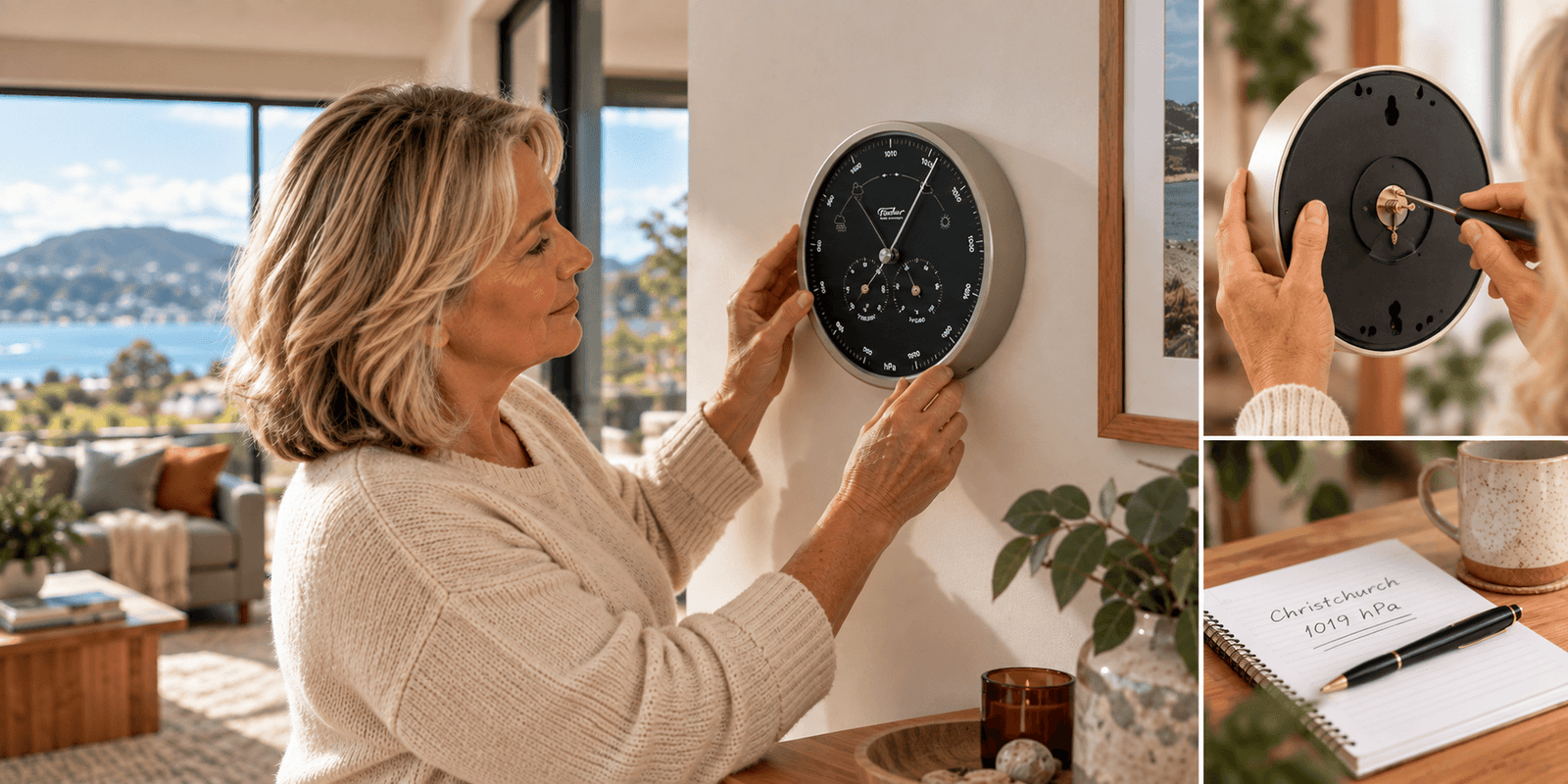

If you've recently purchased a mechanical barometer, you may need to adjust it to match the atmospheric pressure in your location. Fortunately, setting a barometer only takes a few minutes and only needs to be done once unless you move to a different altitude.
Once correctly calibrated, your barometer will automatically respond to changes in atmospheric pressure, helping you predict changing weather conditions.

Step 1 – Find Your Local Barometric Pressure
The easiest way to find your current atmospheric pressure is to search online for:
"Current barometric pressure + your town or city"
Look for a reading measured in:
- hPa (hectopascals)
- mb (millibars)
For example:
Christchurch Barometric Pressure: 1019 hPa
Step 2 – Adjust the Barometer
Turn your barometer over and locate the small adjustment screw on the back.
Using a small screwdriver, slowly turn the screw until the needle points to the current atmospheric pressure for your area.
Take your time and make small adjustments.
Step 3 – Set the Reference Pointer
Most traditional barometers have a movable black reference pointer on the front of the dial.
Turn this pointer so it lines up with the main needle.
This gives you a simple reference point so you can easily see whether the pressure rises or falls during the day.
Step 4 – Tap the Glass Lightly
Mechanical barometers contain delicate moving parts.
After adjusting the needle, gently tap the glass with your finger.
This helps the mechanism settle and ensures the needle is displaying the correct pressure.
Understanding Your Readings
Once your barometer has been set:
- Rising pressure usually means improving weather.
- Steady pressure often indicates stable conditions.
- Falling pressure generally signals rain, wind, or unsettled weather.
The trend over time is usually more important than the actual pressure reading.
Do I Need to Adjust My Barometer Again?
Normally, no.
A quality mechanical barometer only needs adjusting if:
- You move to a different location with a significantly different altitude.
- The instrument receives a heavy knock during transport.
- You want to fine-tune it against your local weather station.
Frequently Asked Questions
Why is my barometer not moving?
Barometric pressure changes slowly. It can sometimes take several hours or even a day before you notice the needle move, especially during settled weather.
Can I damage the barometer by adjusting it?
No. The adjustment screw is designed for calibration. Simply make small adjustments and avoid forcing the screw beyond its normal range.
How often should I check the calibration?
For most homes, checking it once or twice a year is sufficient. High-quality mechanical barometers hold their calibration very well.
Final Thoughts
Setting a mechanical barometer is quick and straightforward. Once calibrated, it will provide years of reliable service and give you a fascinating insight into changing weather conditions.
Watching the pressure rise and fall is not only practical but also one of the pleasures of owning a traditional weather instrument.
Shop Barometers




Leave a comment (all fields required)